

How Did You Do It?

“I don’t know how to put this, but I’m kind of a big deal.”
—Ron Burgundy, Anchorman: The Legend of Ron Burgundy
During my exit interview at the United States Holocaust Memorial Museum, my supervisor asked me a simple question:
“How did you do it?”
He was referring to my ability to excel in an unpaid internship while simultaneously working at Papa John’s and managing a bodega called Field to City. I didn’t have a clever answer. I just shrugged. At the time, it didn’t feel remarkable. It just felt… necessary.
That question stuck with me.
I played college soccer at a small Division II liberal arts school called Salem International University. I chose the school not for its academics, but for its soccer program. My coach was a stern, no-nonsense Romanian with little patience and even less humor. After one particularly disappointing loss, he told us, flatly, “Have a nice life,” as if the season—and perhaps our futures—were over. He said worse things too, but those don’t belong here.
At 5’7” and 140 pounds, I wasn’t the most physically gifted player. I wasn’t the most talented either. What I did have was a role—and I did that role to the best of my ability, every single day.
I also tried to do it with integrity.
In one film session, the coach paused the tape to point something out. A ball had clearly gone out of bounds off the opposing team, but instead of retrieving it quickly to influence the referee, I waited for the call. The coach told me not to do that again. I told him no.
Then, somewhat dramatically, I quoted Matthew 16:26:
“For what good is it for a man to gain the whole world at the price of his own soul?”
In hindsight, that may have been overkill—but it captured something true. I am competitive, but I don’t want to win at all costs.
At my senior end-of-season banquet, the usual awards were handed out: MVP, Most Improved, Rookie of the Year. I didn’t expect my name to be called.
Then Respect by Aretha Franklin started blaring through the speakers.
My coach stepped to the podium and announced a brand-new award: The Utmost Respect Award, created specifically for my twin brother Brandon and me, recognizing our work ethic and integrity. That recognition still means a great deal to me—especially coming from a man who grew up under Communist rule in Romania, lived through the Ceaușescu dictatorship, and experienced the Romanian Revolution firsthand. Praise from him was never casual.
Five months later, I received another honor: the Jack Deloplaine Leadership Award, given annually to one student-athlete who embodies athletic spirit, achievement, and leadership. I shook hands with Super Bowl Champion Jack Deloplaine, a former Pittsburgh Steelers running back and Salem alumnus.
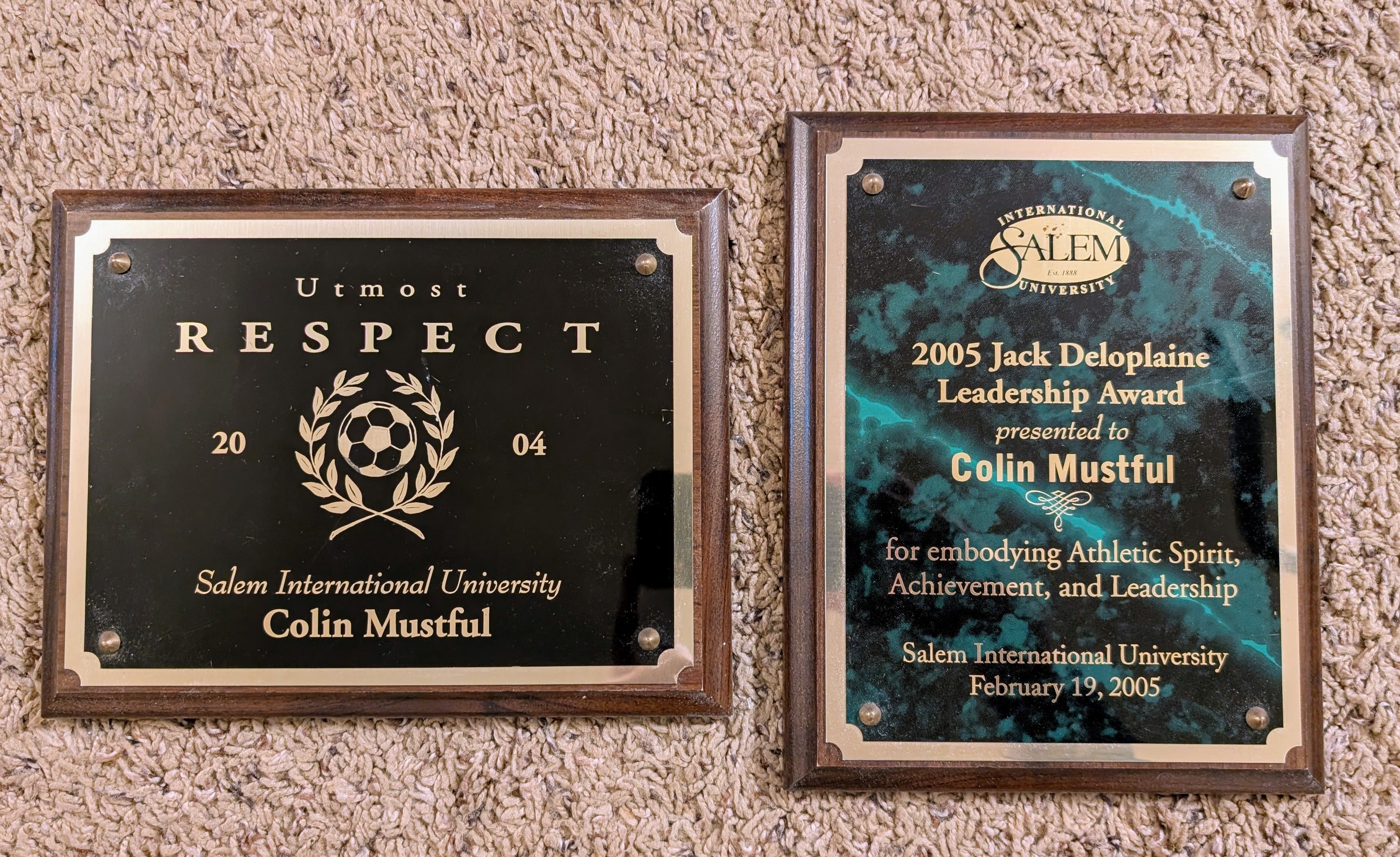
These weren’t isolated moments. In high school soccer, I received the Rebel Award for representing the program with integrity and spirit. In high school baseball, the Hard Hat Award for being the hardest worker. In 2010, I was named Schwan’s USA Cup Minnesota Male Referee of the Year for my work officiating youth soccer.
I don’t share any of this to brag. Most of us, in one way or another, receive recognition when we show up consistently and take our work seriously.
I share it to say this: I am not here by accident.
When people ask me, “How do you do it all?” maybe this post is the closest thing to an answer. This work ethic wasn’t improvised later in life—it was instilled early and reinforced over time. If there’s a guiding principle behind it, it’s Colossians 3:23:
“Whatever you do, do it with all your heart, as unto the Lord.”
When I work with authors—as their editor, their publisher, or both—I don’t make guarantees about outcomes. I can’t control sales, reviews, or algorithms.
What I can guarantee is this:
I will give you my whole heart.
I will work hard.
I will work with integrity.
Even if I’m not the most naturally gifted player on the field, or the smartest and most accomplished publisher in the industry, I will earn your respect—because that’s the only way I know how to work.
If you’re an author who values craft, integrity, and respect for history, we’d love to hear from you.
Learn more about submitting your manuscript to History Through Fiction here:
As you already know, I am Canadian, born and bred in Winnipeg, although I live in Toronto. I did not play hockey, and can barely skate; martial arts was my thing. But since 2011, and the birth of Jets 2.0, I have become a rabid fan. Of my own home city's team, that is, to the point where I have no interest in watching Olympic men's hockey, because I could not cheer for anyone to score on The Jets' starting goaltender, who will be starting in net for Team USA. So I will throw in to watch the Olympic women's hockey, and cheer for my country there.
Reason for giving you this background. What you said about yourself really resonates from all I have learned about hockey from watching it. Especially about leadership. Some teams automatically go crazy over 20-year-old superstars, but most do not. It is no accident that on many teams, the captain, and often assistant captains are the guys who provide leadership in the locker room. Our captain - and even though they had having some difficulties this year, they were first place in the west last year - is the third-line centre, who all the other players have tons of respect for. He will stand up for any of his players, and he will drop gloves and fight anyone who is harassing a teammate. And he is second to none in doing the hard, physical work in the corners to dig out pucks, leading by example.
There are many teams whose captains and leadership groups are of this nature.
Like you said, it's the work ethic.